
The Mitochondrial Triple Lock
Why Most People Completely Misunderstand SS-31, MOTS-c and NAD+

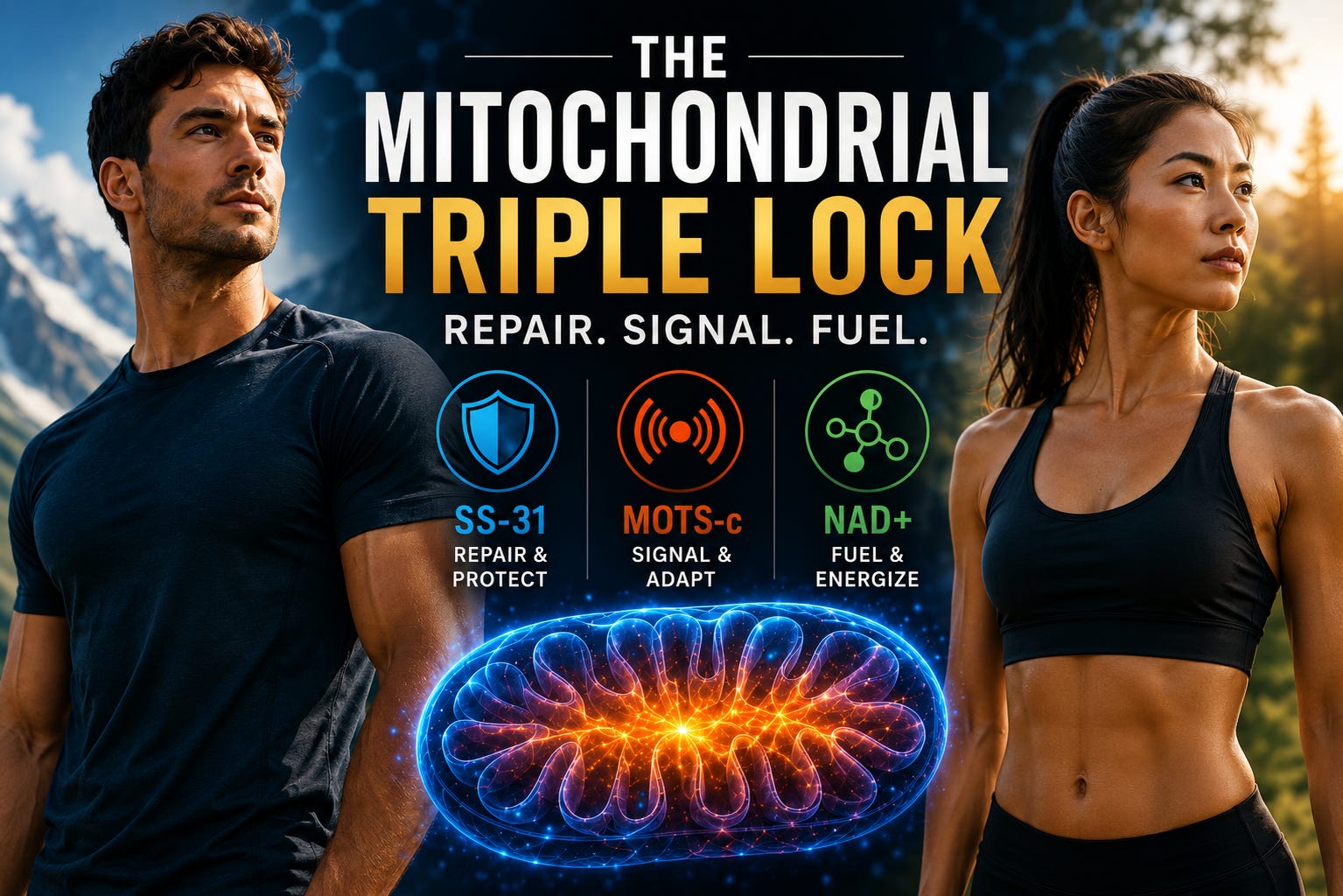
Repair. Signal. Fuel.
The peptide world is currently obsessed with mitochondria.
Every second podcast now promises “cellular energy”, “metabolic optimisation” or “longevity support” through compounds like SS-31, MOTS-c and NAD+.
But listening to much of the online discussion, you would think these compounds all do exactly the same thing.
They do not.
And that misunderstanding is probably one of the biggest reasons many people end up disappointed with mitochondrial “stacks”.
Because most protocols collapse three structurally distinct interventions into one undifferentiated category called “energy boosting”.
That is not what is happening biologically.
A mitochondrion can fail structurally, informationally, or energetically.
And that distinction changes everything.
The rise of the mitochondrial stack
One of the most interesting shifts in peptide culture is how “mitochondrial optimisation” has quietly replaced older biohacker obsessions.
A few years ago, the focus was:
stimulants
testosterone
nootropics
productivity hacks
“dopamine optimisation”
Now the conversation has shifted toward:
fatigue
inflammation
metabolic dysfunction
recovery
ageing
ATP production
oxidative stress
metabolic flexibility
In other words, people are increasingly trying to optimise the engine itself rather than simply slam harder on the accelerator.
That shift is important.
Because the growing interest in compounds like SS-31, MOTS-c and NAD+ reflects something deeper happening culturally: people increasingly suspect that exhaustion is not simply about “being tired”.
They suspect modern life is damaging the body at systems level.
And whether or not every claim surrounding mitochondrial peptides ultimately survives scientific scrutiny, the broader instinct itself is understandable.
Poor sleep. Chronic stress. Sedentary lifestyles. Ultra-processed diets. Circadian disruption. Constant stimulation.
At some point, the question becomes less:
“How do I boost my energy?”
…and more:
“What is happening to the machinery that produces energy in the first place?”
That is where this stack becomes interesting.
The problem with random stacking
The biggest mistake people make is randomness.
People hear a podcast. Buy three compounds. Mix them together. Add caffeine, fasting, cold plunges and six supplements.
Then wonder why results feel inconsistent.
The issue is not necessarily the compounds.
The issue is the framework.
Most mitochondrial stacks fail conceptually because they ignore a simple reality:
These compounds operate on different layers of mitochondrial biology.
They are not interchangeable batteries.
They are three distinct entry points into a single system.
Once you understand that, the logic behind the stack becomes far clearer.
SS-31: repairing the engine
SS-31, also known as elamipretide, is arguably the most structurally targeted compound in this category.
Unlike many “energy boosting” compounds, SS-31 is not primarily stimulatory.
It is architectural.
SS-31 targets cardiolipin, a lipid located within the inner mitochondrial membrane that plays a critical role in mitochondrial structure and electron transport efficiency.
When cardiolipin becomes damaged, mitochondria become inefficient. Energy production drops. Oxidative stress rises.
The analogy many people use is surprisingly accurate:
SS-31 does not simply pour more fuel into the engine.
It attempts to stabilise and repair the engine itself.
That distinction matters enormously.
Because trying to “boost energy” inside dysfunctional mitochondria can sometimes resemble revving a damaged car harder and harder.
People discussing SS-31 often focus on:
endurance
recovery
fatigue reduction
cognitive clarity
exercise tolerance
But mechanistically, the more interesting concept is mitochondrial integrity.
Not stimulation.
Integrity.
MOTS-c: the metabolic signal
MOTS-c is completely different.
It is not primarily structural.
It is signaling-oriented.
MOTS-c is a mitochondria-derived peptide involved in metabolic regulation and cellular stress adaptation. Much of the excitement surrounding it comes from its relationship with:
AMPK activation
insulin sensitivity
glucose utilisation
metabolic flexibility
exercise adaptation
In practical terms, many people view MOTS-c as a compound associated with:
improved stamina
fat metabolism
metabolic efficiency
body composition support
endurance enhancement
But the important conceptual point is this:
MOTS-c is less about “creating energy” and more about influencing how the body responds to and allocates energy.
That makes it fundamentally different from both SS-31 and NAD+.
It is informational rather than structural.
A signaling layer rather than a repair layer.
And that is exactly why many people choose to cycle it instead of running it continuously.
NAD+: the fuel layer
Then comes NAD+.
Technically not a peptide, but impossible to ignore in any mitochondrial discussion.
NAD+ sits at the centre of cellular energy production and mitochondrial respiration. It acts as a critical cofactor involved in ATP generation, cellular repair pathways and metabolic function.
And this is where the stack becomes genuinely interesting.
Because once you separate the compounds mechanistically, the architecture becomes clearer.
SS-31 primarily functions as a structural repair and mitochondrial protection compound. Its focus is mitochondrial integrity and stabilisation.
MOTS-c functions more as a metabolic signaling and adaptation peptide. Rather than directly “creating energy”, it influences how the body senses, allocates and utilises energy.
NAD+ operates as the energy support and cellular fuel layer. It plays a central role in mitochondrial respiration, ATP generation and broader cellular repair pathways.
That framework is far more useful than the usual “take all three for more energy” narrative dominating social media.
One repairs.
One signals.
One fuels.
That is the “Triple Lock”.
Why this stack resonates with people
The popularity of this stack says something important about modern health culture.
People increasingly feel metabolically overwhelmed.
Not just tired.
Overwhelmed.
And many suspect the issue is deeper than motivation or discipline.
The language around mitochondrial optimisation reflects a broader cultural shift toward systems-level thinking:
recovery instead of stimulation
resilience instead of brute force
metabolic flexibility instead of crash dieting
longevity instead of short-term performance spikes
Ironically, this may explain why mitochondrial content exploded in popularity so quickly.
People are exhausted by living in permanent overdrive.
And the idea of “repairing the energy system itself” is psychologically powerful.
Whether the biology ultimately justifies all the hype remains an open question.
But the appeal is obvious.
The timing problem nobody talks about
One of the more intelligent points raised in the original podcast discussion was that timing and sequencing probably matter far more than most people realise.
The common mistake is treating these compounds as if they are interchangeable “energy enhancers”.
But if they operate on different biological layers, then structure suddenly matters.
Conceptually, many people approach the stack something like this:
NAD+ earlier in the day to support energy availability
MOTS-c intermittently to influence metabolic signaling and exercise adaptation
SS-31 consistently over a longer period to support mitochondrial integrity and repair
Whether that exact structure is optimal remains scientifically unresolved.
But the broader idea is important:
Systems biology usually responds better to consistency and intelligent sequencing than random escalation.
That is true in physiology generally.
Not just peptides.
The uncomfortable reality
There is, however, an uncomfortable truth that the peptide world sometimes avoids discussing.
Many people are trying to optimise mitochondria while simultaneously:
sleeping five hours
consuming ultra-processed food
barely moving
chronically stressed
living on stimulants
existing in permanent sympathetic overdrive
At some point, the environment surrounding the mitochondria matters more than the stack itself.
And that raises an uncomfortable possibility:
Some people are not suffering from a lack of peptides.
They are suffering from modern life.
No mitochondrial stack can fully compensate for:
chaos
sleep deprivation
chronic inflammation
inactivity
relentless stress
Which is why the most sophisticated way to think about these compounds is not as magic solutions.
But as tools layered on top of a functioning foundation.
A better framework
Instead of asking:
“What gives me energy?”
The better questions may be:
Am I supporting mitochondrial structure?
Am I supporting metabolic signaling?
Am I supporting energy production?
Am I sleeping properly?
Am I recovering properly?
Am I constantly overstimulating myself?
Am I expecting compounds to compensate for lifestyle dysfunction?
That is a far more intelligent framework than blindly stacking compounds because a podcast host called something “next level”.
And ironically, that may be the most useful insight of all.
Final thoughts
The most interesting aspect of the SS-31 + MOTS-c + NAD+ discussion is not whether the stack is “magic”.
It is that the conversation reflects a major shift in how people now think about ageing, fatigue and performance.
The peptide world is gradually moving away from crude stimulation and toward systems-level optimisation.
Whether the current mitochondrial obsession ultimately lives up to the hype remains to be seen.
But one thing already seems clear:
The future of biohacking will probably revolve less around “boosting” the body…
…and more around understanding how energy is actually created, regulated and protected in the first place.
And perhaps that is the real story behind the mitochondrial gold rush.
Not the promise of infinite energy.
But the growing suspicion that modern life itself may be metabolically incompatible with how humans were designed to live.